
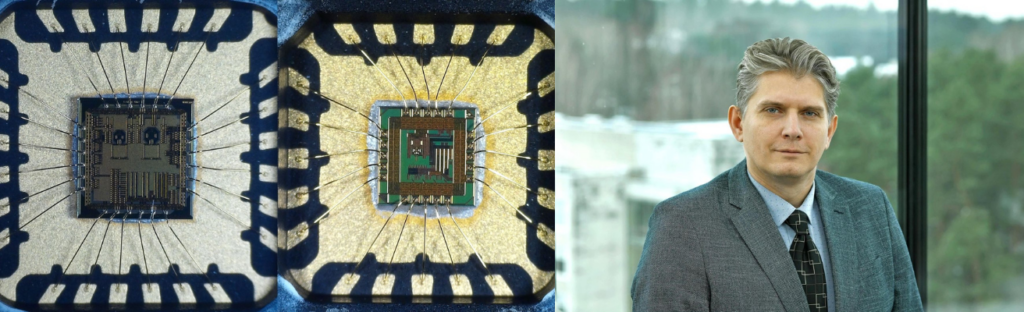
As global demand for chips continues to grow, more countries are seeking ways to establish themselves in the semiconductor value chain. Professor Vaidotas Barzdėnas, Head of the Department of Computer and Communication Technologies at VILNIUS TECH and Chief Researcher at the Lithuanian Chips Competence Centre (ChipsC²-LT), says that strong R&D capabilities, niche solutions, and the synergy between science and business give Lithuania a competitive advantage. The academic base, he notes, enables this potential to be systematically developed into high value-added solutions.
Barzdėnas explains that several key trends are currently shaping the global semiconductor market.
“As artificial intelligence (AI) and machine learning technologies rapidly evolve, there is an increasing demand for specialized accelerator chips and systems capable of efficiently processing large data streams and performing complex computations in real time. The expansion of 5G and other telecommunications solutions is also driving demand for high-speed, energy-efficient chips. These enable large-scale data transmission and ensure high network reliability. The automotive sector is another driver, increasing the need for sensors, controllers, and power management circuits, especially in electric and autonomous vehicles,” he says.
According to the professor, the growing demand for IoT (Internet of Things) solutions is also contributing, as this sector requires low-power, compact, and cost-effective chips capable of operating across various industrial, household, and infrastructure systems. The defense sector—particularly drone technologies and advanced communication and image-processing systems—creates additional demand for highly specialized chips capable of real-time complex computations in critical applications.
“Finally, technological progress in semiconductor manufacturing, including advanced 2–7 nm processes, enables the creation of more efficient, smaller, and more powerful devices, accelerating market growth,” Barzdėnas adds.
He notes that these changes open opportunities for developing new products and technologies across both consumer and industrial sectors. Importantly, these trends are reshaping competition—scale is becoming less important than the ability to create specialized solutions. This is precisely where Lithuania sees new opportunities.
Barzdėnas acknowledges that Lithuania is not yet capable of competing globally in large-scale semiconductor manufacturing or advanced technology production with major players such as Taiwan, the United States, or leading Asian and EU countries. However, it actively participates in the technology ecosystem by developing innovations, designing prototypes, and integrating specialized electronic solutions.
“We do not yet have large semiconductor fabrication plants or very strong institutions focused on cutting-edge chip technologies. Nevertheless, Lithuania has many companies developing innovative products and actively competing in research and development (R&D). Their work is often based on intellectual property solutions, allowing them to offer unique and distinctive products to the market,” he emphasizes.
He highlights the laser and photonics industry, as well as other high-tech sectors such as communication technologies and IoT systems, where innovation strengthens Lithuania’s technological profile and enables globally competitive solutions.
Decades of competence building
The current potential has been built over decades. Lithuania began developing semiconductor expertise as early as the 1960s, when a microelectronics company was established in Vilnius, later becoming the “Venta” research institute and manufacturing plant. Integrated circuits were developed and produced there, forming a strong engineering culture.
“After regaining independence, Lithuania chose a path aligned with its capabilities. Since large-scale chip manufacturing requires enormous investment, the focus shifted to strengthening design competencies. Universities and research centers became the main drivers of this development,” Barzdėnas explains.
Today, Lithuania’s semiconductor ecosystem is not concentrated in one area—different institutions have developed complementary strengths.
“VILNIUS TECH stands out in high-frequency integrated circuits, 5G communication systems, optoelectronics, and image sensor development. The Center for Physical Sciences and Technology is strong in THz electronics, advanced semiconductor structures, and photonics. Other universities, such as Vilnius University and Kaunas University of Technology, contribute through fundamental semiconductor research, signal processing, microelectronics, and system design,” he says.
Business, meanwhile, focuses primarily on high value-added R&D activities—developing critical chip components that define product uniqueness.
From studies to real-world solutions
Professor Barzdėnas explains that the Faculty of Electronics at VILNIUS TECH, as part of ChipsC²-LT, acts as a hub connecting science, education, and practical application.
“The Faculty has long-standing traditions in integrated circuit and chip design. Its bachelor’s and master’s programs in Electronics Engineering provide strong theoretical foundations and practical skills in micro- and nanoelectronics, as well as in designing both analog and digital integrated circuits,” he says.
Students actively participate in international projects, collaborate with foreign universities, attend summer schools, and gain both technical and soft skills, including teamwork, project management, prototyping, and real-world problem solving.
In recent years, collaboration between academia and industry has strengthened significantly.
“Companies increasingly turn to universities not only to solve specific problems but also to develop their employees’ competencies. Some professionals return to study courses related to chip design and micro/nanoelectronics, strengthening both theoretical knowledge and practical skills,” Barzdėnas notes.
He adds that companies also seek support for complex measurements and testing, while startups are increasingly engaging with universities to develop innovative ideas.
Breakthrough through specialization
These partnerships and accumulated competencies shape the sector’s future direction. According to Barzdėnas, in the coming decade, chips developed in Lithuania could become a key driver of technological and industrial transformation, particularly in niche, high-value solutions.
“Lithuania’s strength lies in science and R&D, not mass production. Our competitive advantage is in creating specialized, high value-added solutions tailored to specific systems or products,” he says.
This trend could further strengthen Lithuania’s already competitive laser and photonics sector by integrating advanced semiconductor solutions.
He also highlights the importance of major industry players such as Teltonika, whose investments in semiconductor technologies could significantly boost the entire ecosystem—from idea to application in transport, energy, healthcare, and beyond.
According to Barzdėnas, universities and research institutions will play a crucial role by generating new knowledge, training highly qualified specialists, and enhancing existing expertise.
“ChipsC²-LT will play an increasingly important role in this ecosystem. It is ready to support companies and startups with knowledge, research infrastructure, and expertise. At the same time, innovations being developed at VILNIUS TECH—including 5G and satellite communication technologies, image processing, and their applications in drones and medical equipment—along with support for AI and machine learning chip startups, will drive the emergence of new R&D startups and inspire a major breakthrough in Lithuania,” concludes Barzdėnas.