

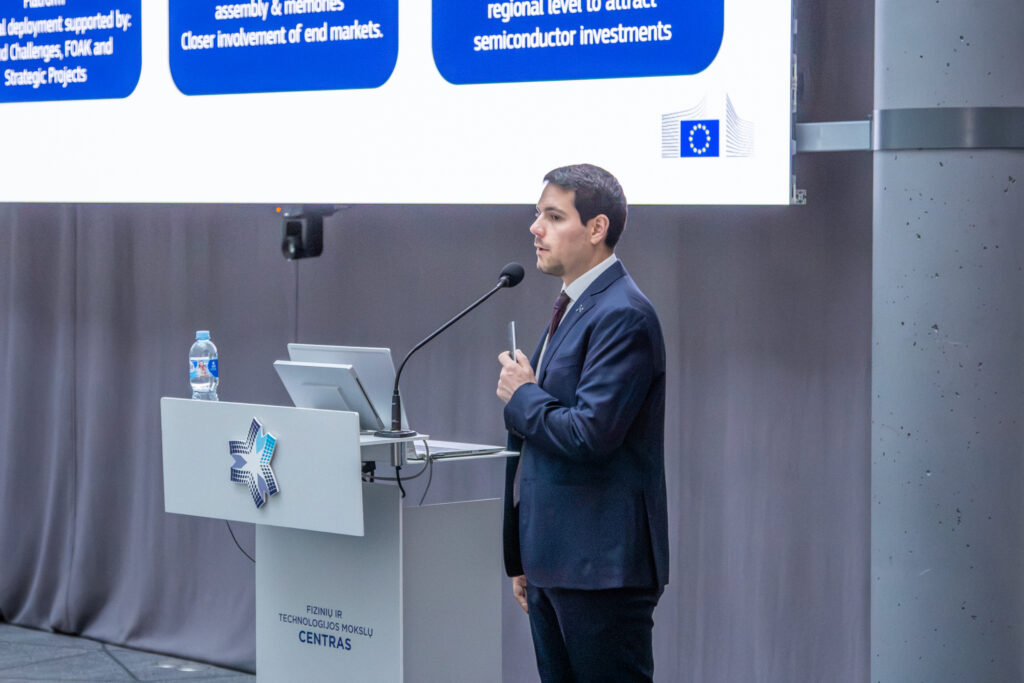
On 21 September, Zeno Tornasi, Policy Officer for Microelectronics and Photonics at the European Commission’s DG CNECT, visited Vilnius to present the proposed Chips Act 2.0 and hear directly from Lithuania’s semiconductor ecosystem.
The workshop, organised by ChipsC²-LT, the Lithuanian Chips Competence Centre, at the Center for Physical Sciences and Technology (FTMC), brought together 42 participants from industry, ministries, universities and Baltic competence centres.
The outcome was concrete: eight proposals for strengthening Lithuania’s role in the European semiconductor ecosystem, set out in a one-page position paper and submitted to the European Commission and the Ministry of the Economy and Innovation. The proposals will also contribute to Lithuania’s national position ahead of its Presidency of the Council of the EU in January 2027.
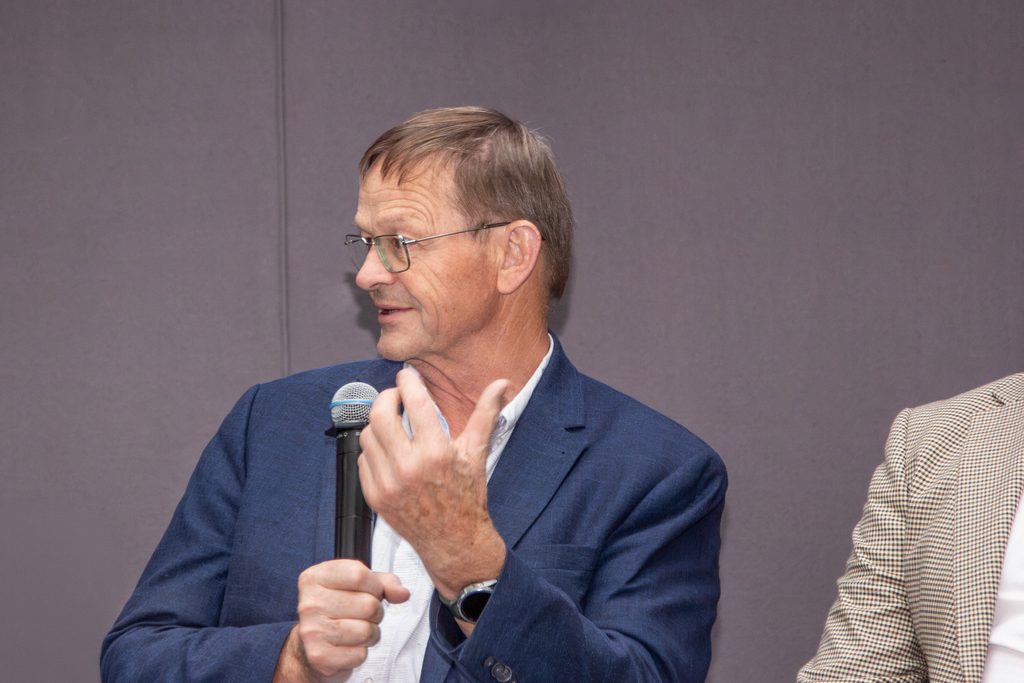
Gediminas Račiukaitis, coordinator of ChipsC²-LT. Photo: FTMC
A broader Chips Act opens opportunities for Lithuania
The proposed Chips Act 2.0 expands the focus beyond semiconductor manufacturing to the wider value chain, including equipment, materials, packaging, assembly and testing.
This is particularly relevant for Lithuania. While the country does not have a front-end semiconductor fab, it has established capabilities in lasers and photonics, electronics manufacturing, IC design, semiconductor equipment and research infrastructure.
Zeno Tornasi stressed that technological capabilities alone are not enough to bring innovations to industrial scale: demand is equally important. The new proposal therefore places greater emphasis on demand-side measures, including applications in defence, drones and data centres. He also confirmed that Chips Competence Centres are expected to continue under the new framework.
Lithuania’s priorities
The discussion identified several areas where European policy could make a practical difference.
Gediminas Račiukaitis, coordinator of ChipsC²-LT and president of the Lithuanian Laser Association, highlighted the lab-to-fab gap and the high cost of producing initial chip prototypes in Europe. He also stressed the need for universities and SMEs to access commercial-grade design tools and for photonics to be understood beyond photonic integrated circuits.
Other speakers presented Lithuania’s capabilities and priorities in IC design, defence electronics, semiconductor packaging and testing, photonics, equipment and talent development.
One of the key initiatives discussed was Semikona’s proposal for an open-access assembly and test (OSAT) facility in Lithuania, aimed at strengthening Europe’s semiconductor back-end capabilities.
The panel discussion, moderated by Saulius Tumėnas, head of ChipsC²-LT, and joined by Pauls Irbins, head of the Latvian Chips Competence Centre, highlighted an important point: projects become strategic under the Chips Act only after they are adopted as national priorities by Member States.
For Lithuania, this puts the next step at national level, building agreement between industry, research institutions and policymakers on which priorities should move forward.

Saulius Tumėnas, head of ChipsC²-LT. Photo: FTMC
“The most important message of this event is that the Chips Act 2.0 for the first time covers the whole semiconductor value chain, and those are exactly the areas where Lithuanian laser, photonics and electronics companies already work,” said Saulius Tumėnas. “From January, Lithuania will hold the Presidency of the Council, giving us a real opportunity to contribute to shaping the final text.”
Eight proposals, two routes forward
The one-page position developed following the workshop contains eight proposals covering:
- fair access for smaller Member States;
- closing the lab-to-fab gap;
- access to the full semiconductor design ecosystem;
- greater access to European pilot lines;
- the future of Chips Competence Centres;
- a broad definition of photonics;
- equipment-focused funding opportunities;
- eligibility of industrial end-users.
The proposals have now been submitted to the European Commission as ecosystem input and to the Ministry of the Economy and Innovation as material for Lithuania’s national position.
ChipsC²-LT will continue coordinating with the Latvian and Estonian Chips Competence Centres to bring Baltic priorities into the European discussion.
With Lithuania taking over the Presidency of the Council of the EU in January 2027, the coming months will be an important opportunity to bring these priorities into the debate on the future of Europe’s semiconductor industry.