
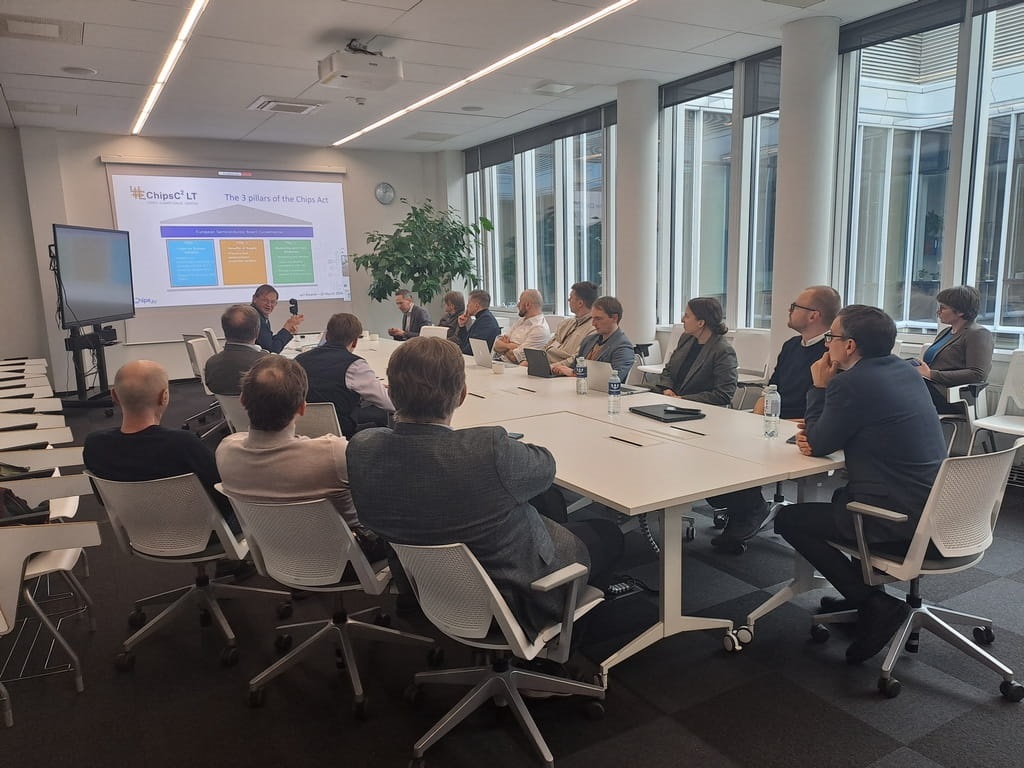
On January 15, 2026, the first Industry Advisory Board meeting of the ChipsC2-LT project took place. An Industrial Advisory Board (IAB) is established to align the ChipsC2-LT consortium activities to better fulfil current and future industry demands. The event brought together representatives from Lithuanian semiconductor and electronic industry companies: UAB Teltonika IoT Group, UAB Esemda, UAB Brolis Semiconductors, UAB Sintecs, UAB Elinta, UAB Lime Microsystems, Blue Flight investors, the Lithuanian Innovation Agency and project partners. The main objective of the meeting was to gather industry input on ChipsC2-LT service portfolio and identify how the centre can best address real company needs.
During the event, ChipsC2-LT project activities and planned initiatives were presented, followed by structured feedback from industry representatives. A representative from Brolis Semiconductors provided valuable insights to research institutions, noting that while university students acquire strong fundamental knowledge, practical skills are often lacking. Industry representatives also emphasised the need to strengthen the practical training component by more closely integrating real industry needs into study programs and research processes.
The project partners – Vilnius TECH, Kaunas University of Technology (KTU), and Vilnius University (VU) – presented their semiconductor study programs, curricula, and graduate preparedness levels, as well as opportunities for industry engineers to deepen their knowledge and competencies using the universities’ semiconductor R&D equipment. Particular attention is given to the study programs’ ability to prepare specialists capable of solving not only theoretical but also practical challenges in the semiconductor industry. Progress is already being made – university representatives emphasised that study programs aim not only to develop semiconductor design capabilities but also increasingly focus on practical technology implementation and understanding of manufacturing processes. KTU has established the Chip Academy, which will develop and commercialise high-reliability chip technologies to address current and future regional, business, and industry needs. Vilnius Tech and KTU also already have accredited Bachelor’s/Master’s degree programs in electronic systems and integrated circuit design.
Industry feedback will guide ChipsC²-LT’s coordination of service delivery across its four partner institutions. Industry representatives encouraged research institutions to more actively identify and develop innovative ideas created by researchers, which currently often remain underutilised. These so-called “golden ideas” could become the foundation for new technologies, products, or services.
SMEs and startups expressed particular interest in ChipsC²-LT’s one-stop-shop approach, which provides access to design tools, clean rooms, and testing facilities across all four partner institutions.
The event also revealed different expectations from industry companies. Large semiconductor industry companies are more concerned with the shortage of qualified engineers and the high market demand for them. Meanwhile, SMEs and startups are more interested in gaining access to semiconductor technologies through university and European pilot line infrastructure. The feedback gathered at this inaugural IAB meeting will directly shape ChipsC²-LT training programs, infrastructure access procedures, and support services. The IAB will meet twice yearly to ensure the centre remains aligned with evolving industry needs.