

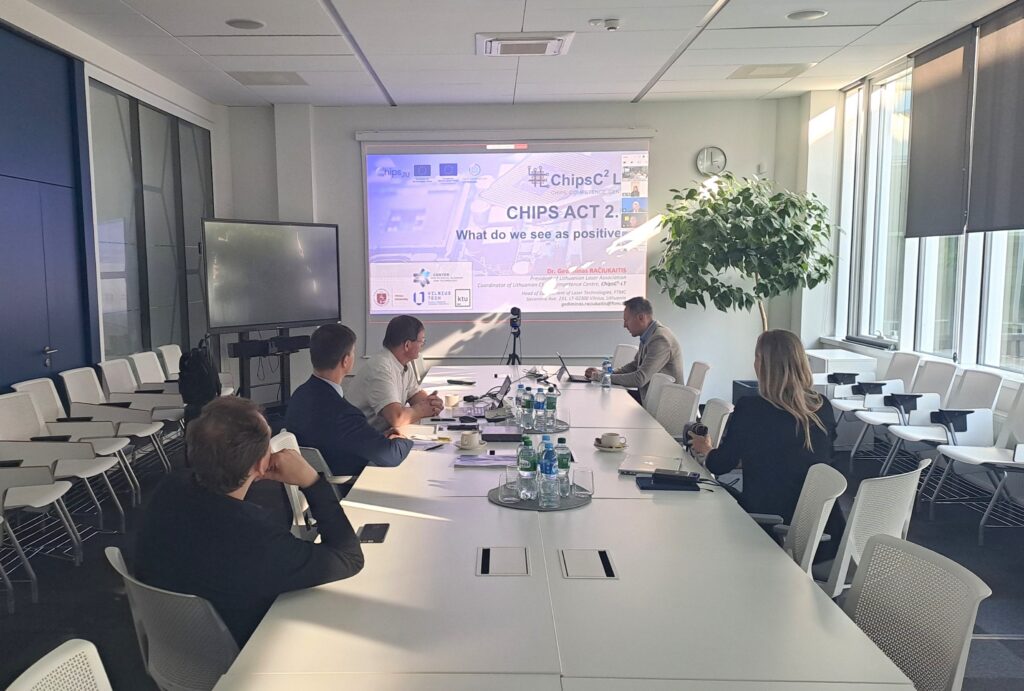
On 2 October, a roundtable discussion on the European Commission’s proposal for the “Chips Act 2.0” was held at the Center for Physical Sciences and Technology (FTMC), at the initiative of Member of the European Parliament Paulius Saudargas. The event was organised by Paulius Saudargas together with Dr. Gediminas Račiukaitis, Coordinator of the Lithuanian Semiconductor Competence Centre ChipsC²-LT and President of the Lithuanian Laser Association, and Dr. Saulius Tumėnas, Head of the Centre. Oliver Schenk, the European Parliament’s rapporteur on the Act and a member of the Committee on Industry, Research and Energy (ITRE), joined the discussion remotely. Representatives of Lithuania’s semiconductor and photonics ecosystem, research institutions and the Innovation Agency Lithuania also participated in the discussion.
The discussion focused on three key topics: Lithuania’s perspective on the new Act; strategic projects, including planned semiconductor assembly and testing (OSAT) capabilities in Lithuania; and the role of photonics in Europe’s semiconductor policy. Presentations were delivered by Dr. Gediminas Račiukaitis and Austėja Pliupelytė, representing the Innovation Agency Lithuania.
The new Act covers the entire semiconductor value chain, from materials and manufacturing equipment to packaging and testing. According to the participants, this is precisely where Lithuanian companies operating in laser technology, photonics and electronics can make a particularly strong contribution. The discussion produced several concrete proposals, including the need to adopt a broad understanding of photonics in the Act – not limited to photonic integrated circuits, but also encompassing laser technologies used in semiconductor manufacturing; to assess strategic projects based on their contribution to addressing gaps in Europe’s supply chains rather than solely on their scale; to ensure that funding opportunities are accessible to smaller Member States; and to reduce the cost of semiconductor prototyping for universities and small companies.
The European Parliament’s position on the Act is currently being prepared within the ITRE Committee. This process is of particular importance to Lithuania: from January 2027, Lithuania will hold the Presidency of the Council of the European Union, providing additional opportunities to contribute to the final text of the Act and strengthen the position of its technology sector within European value chains.
The activities of ChipsC²-LT are co-funded by the European Union under the Digital Europe Programme (Grant Agreement No. 101217991).